Imereti
Imereti is a region and historical region in Western Georgia.The capital of the region is the city of Kutaisi, located on both banks of the Rioni River.The advantage of a holiday in Imereti is the climatic conditions. Still, there is no extreme heat or cold. This is a big plus in order to take walks around the city, see the sights and just enjoy a different atmosphere, an atmosphere of relaxation.Tourism is possible there at any time of the year, especially since most of the temples in Georgia that believers seek to visit are located in large cities, which are easily accessible by various means of transport.
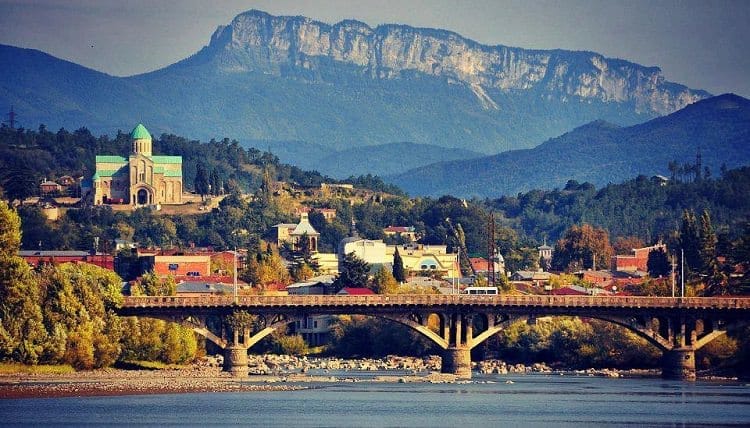
Kutaisi was founded in the 6th-5th centuries BC, according to archaeological excavations. The documentary history of Kutaisi begins in the 3rd century BC. It was in Kutaisi, the capital of the Colchian Kingdom), that the Argonauts went to King Ayet for the Golden Fleece. A drama theater has been operating in the city since the end of the 19th century, as well as an opera house.The State Historical Museum of Georgia, the Museum of Military Glory and the Museum of Sports are located here. In 2012, the construction of the new Georgian Parliament building was completed, which will move here from Tbilisi. The first meeting of the newly elected Parliament was held on October 21, 2012.
The main attraction of the city of Kutaisi is one of the largest Bagrati temples in Georgia.It stood in a dilapidated state for three hundred years and was restored in August 2012, despite the protests of the patriarch and the discontent of private individuals. The temple was built in Kutaisi during the reign of Bagrat III, as the main cathedral of his united Georgian kingdom and consecrated in honor of the Dormition of the Virgin in 1003.Majestic in size and proportions, the temple has become a fundamentally new word in the history of Transcaucasian architecture.The temple was lavishly decorated with carvings and mosaics and played an exceptional role in the medieval history of Georgia. In particular, it was here that David IV the Builder was crowned. August 17th, 2012. A two-meter bronze cross weighing 300 kg is installed on the dome of Bagrat's temple. The cross was designed by architect Vano Gremelashvili. The cross is visible from all points of Kutaisi.. The temple offers wonderful views of the whole of Kutaisi, the Rioni River and even the Rachinsky ridge.
The Gelati Monastery of the Virgin near Kutaisi is the most significant medieval monastery in Georgia. The center of church and cultural life, the residence of the Catholicos from the 2nd half of the XVI century to 1814, a World Heritage Site. The monastery was founded by King David IV the Builder in 1106 and became his tomb. The Cathedral church was built before 1125 and for another five years it was decorated with mosaics, which are revered as the best in the whole of Transcaucasia. At that time, the monastery was the seat of the Gelati Academy, whose members were keenly interested in ancient Greek philosophy.In the 13th century, the churches of St. Nicholas were added to the monastery ensemble. St. Nicholas and St. George, as well as a three-tiered belfry. The murals belong to different periods of Georgian history, from the 12th to the 18th centuries; especially noteworthy are the portrait images of crowned heads. Previously, many valuable icons and objects of applied art were preserved in the monastery; in Soviet times they were seized and distributed to museums. In the 14th century, the monastery was partially destroyed by the Mongols, and rebuilt in the 15th century.
Very close to the Gelati Monastery is the Motsameta Monastery, it is called the Monastery of Saints David and Constantine. At the beginning of the 8th century, there was a church here. During the invasion of the Arab army of Mervan the Deaf (735), the Arabs burned down the church. The entire area of the Likh range was then called Argveti, it was ruled by Mtavars David and Konstantin, whose residence was the Shorapani fortress. They went out with an army against the Arabs, but were defeated and captured. For some reason, Mervan wanted to convert them to Islam and win them over, but they refused. They were tortured for 9 days, then drowned in the river Rioni. When their bodies were found on the shore, people heard the voice of God, who ordered them to be carried east to the place where dawn would catch the procession.
This place turned out to be the ruins of a burnt church, about 3 kilometers from Rioni. David and Konstantin were buried there. At the beginning of the XI century, Tsar Bagrat III built a large domeless temple and founded the monastery "motsameta" (martyrs). At about the same time, the "Martyrdom of David and Constantine" was compiled. Sometime after 1844, Bishop Levan Tsereteli of Imereti renovated the church and built the dome that we see now.In 1923, the Soviet government came and the monastery was closed. In the same year, on Ordzhonikidze's orders, the bodies of David and Konstantin were pulled out of the grave. They were tied to a horse and dragged along the road all the way to Kutaisi. Which, by the way, means that these were not just bones, but entire bodies. Then they were thrown into the river. Local residents managed to pick up some parts of the relics and later they were kept in the Kutaisi museum. Now there are several buildings on the territory of the monastery: the Cathedral of the Martyrs David and Constantine, a bell tower built in 1845 and a stone wall with a tower.
Tskaltubo is a city in western Georgia, the administrative center of the Tskaltuba district; 9 kilometers northwest of Kutaisi. The first mention of Tskaltubo dates back to the 7th century. In the XII—XIII centuries it was already mentioned as a medical center. The main therapeutic ingredient of the resort is mineral water. Chemists talk about its uniqueness, and paleontologists say that this water was formed 100-150 thousand years ago.In 1920, the springs came under state control and received the function of a balneological resort. The development of the resort began in 1926. In 1931, the General Secretary of the Central Committee of the CPSU visited the resort. V. Stalin, in connection with the need for treatment.About 100 varieties of subtropical flora are represented in the Tskaltubo Resort Park. The surrounding hills are covered with deciduous forests with evergreen shrubs. The local mild climate without sudden fluctuations and sweltering heat is perfect for people suffering from various ailments. A mixture of mountain air, sea breeze and the fragrance of subtropical plants filled with phytoncides – all this makes the local atmosphere extremely useful for the healing process.
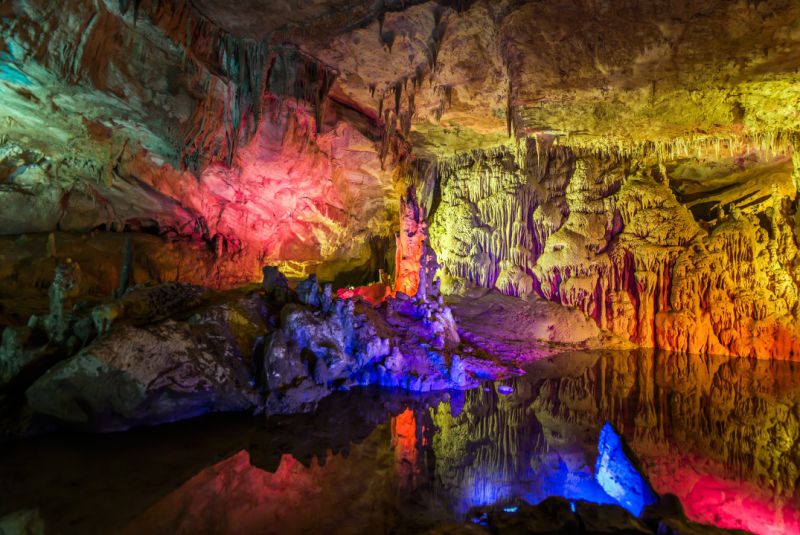
Not far from the town of Tskaltubo and about 10 kilometers from Kutaisi is the largest cave in Georgia — Kumistavi Cave, renamed Prometheus Cave in 2010. After the cave was discovered in 1984, it was almost immediately made a tourist attraction. Only a tenth of it is open to tourists, and even so, a walk through the cave takes almost an hour. There are underground lakes and rivers inside, there is very high humidity and there are bats, which, however, do not bother tourists because they fly very high. Today, Prometheus Cave, surrounded by a specially designed natural area with a radius of 3 kilometers, is one of the most tempting places for visitors to Georgia. Visiting the cave provides a unique opportunity to see the underground world of this region in all its glory. Tourists can choose a 1600-meter hiking route through the caves and/or a boat trip along a real underground river. The route passes by breathtaking stalactites and stalagmites, underground waterfalls, rivers and even an entire lake. A multi-colored underground lighting system based on liquid crystal lamps and classical music constantly playing in the cave adds a magical feeling to all this, which makes the route even more attractive and memorable. The interior maintains a comfortable air temperature of about 14 degrees Celsius, which makes the cave open to tourists all year round. Kumistavi got its resonant tourist name "Prometheus Cave" due to the famous Caucasian myth of Amirani, who, like Prometheus, angered the gods, which is why he was punished. For days and nights, the eagle tormented his liver; however, unlike the ancient Greek titan, Amirani was chained by the cruel gods not outside, but somewhere inside a large cave. Presumably, it is inside Kumistavi.
Not far from Kumistavi there is another famous cave, Sataplia, so enterprising travelers quite often combine their visits. The Sataplia Nature Reserve was founded more than 75 years ago, and it was seriously renovated a few years ago. The three main attractions of the reserve are a pavilion with preserved dinosaur footprints, a karst cave and a glass balcony — observation deck at the top of Mount Satapli. Dinosaur tracks were found in the 1930s by one of the residents of the surrounding villages, and a few years later a nature reserve was established on this site. This reserve is sometimes also called "honey", as "tapli" means honey in Georgian, and this place was once home to whole flocks of wild bees, whose honey was enjoyed by local residents. With the arrival of tourists, there are very few bees left, but walking through the Sataplia reserve, you can still meet the most persistent representatives of the genus.
There is a canyon located 50 kilometers from the city of Kutaisi in western Georgia, which is the gorge of the Okatse River, from which it got its name. At the moment, it is one of the most popular natural attractions in the country.Since September 2014, it has been landscaped and open to tourists. The tourist center is located in the village of Zeda Gordi, and after visiting it, guests get on a trail that will eventually lead them to the suspension bridges.
It is more than a kilometer long and up to 140 meters high above the cliff, which is about 45 floors. The sight is certainly exciting and in some ways extreme, especially for those who are not a big fan of heights. But before getting to the bridges, tourists pass a 2.2-kilometer-long trail stretching through a picturesque forest, where, in addition to natural beauty, you can explore the ruins of the 18th-century Dadiani Princes' palace.
Previously, the beauty and grandeur of Okatse Canyon was little known and difficult to access for visitors. But with the development of tourism in Georgia, this creation of nature has been improved and opened for public viewing. Now you can find many sightseeing tours, travelers and simple connoisseurs of virgin nature here.
